Noise countermeasures for battery energy storage systems are important to plan even before equipment installation. With the spread of renewable energy, the installation of grid-scale battery energy storage systems (BESS) is rapidly advancing. On the other hand, cases of trouble with nearby residents are increasing due to noise generated by cooling fans and power conditioners.
This article explains useful information from before installation to after installation, covering the causes of noise in battery storage systems, regulations, and effective countermeasures.
Noise problems and causes due to storage batteries
Increasing battery noise problems
In recent years, as efforts towards a carbon-neutral society accelerate, the adoption of Battery Energy Storage Systems (BESS) has been rapidly expanding across various locations such as factories, commercial facilities, residential areas, hospitals, and schools.
However, along with the increase in installations, complaints from neighbors such as "a low humming sound continues even at night" and "mechanical noise is noticeable even indoors" have also increased. This is particularly true for grid-scale battery storage systems, which are designed for 24-hour continuous operation. The noise tends to be more noticeable and problematic in the quiet nighttime environment.
Main noise sources and characteristics
Noise generated by battery storage systems can originate from multiple pieces of equipment. Understanding the characteristics of each is the first step toward effective countermeasures.
Noise levels vary by manufacturer.
| Source | Characteristics of noise | Reference dB |
| Power conditioner | Switching noise during AC/DC conversion. An electromagnetic sound like "buzzing" occurs. | Approximately 55-75dB |
| Cooling fan | The higher the load, the higher the speed and the louder the noise. | Approximately 50-70dB |
| Battery unit main body | Electromagnetic sounds generated during charging and discharging. Especially large in large facilities. | 55-85 dB (over 100 dB for large ones) |
| Air conditioning equipment | Outdoor unit noise for equipment room temperature control | Depending on the installation conditions |
Noise Level Guidelines and Impact on Daily Life
| Noise Level | Examples of everyday sounds | Impact on daily life and conversation |
| 40dB | Quiet residential area (daytime) | I barely notice it. |
| 50 dB | Quiet office and home air conditioner outdoor unit | Relatively quiet. Some people might start to notice it. |
| 60dB | Standard conversation - battery unit (medium) | Level at which everyday noise becomes easily noticeable |
| 70dB | Vacuum cleaners and system storage batteries (general) | It's difficult to converse unless you raise your voice. It feels noisy. |
| 100dB | Under-the-train tracks, large-system backup battery | Potential hearing effects from prolonged exposure |
Due to nighttime noise being 5-10 dB quieter than daytime noise, the perceived level of noise increases. Even if noise is within the "acceptable range" during the day, it often becomes a subject of complaint at night, making it particularly important to implement measures with nighttime standard values in mind.
Noise Regulation Act and Standard Values
Difference between the "Noise Control Law" and "Environmental Standards"
When considering noise countermeasures for battery storage systems, it is important to first understand the difference between the "Noise Regulation Act" and "Environmental Standards." These two have different natures and require different responses.
| (data) item | Noise Regulation Act | Environmental standards |
| Objective. | To regulate noise from specific facilities and specific construction activities and preserve the living environment. | Establish standards that are desirable to maintain for the protection of human health and the preservation of the living environment. |
| Legal Character | Regulatory standards (penalties apply for violations) | Administrative Objectives (Aspirational Goals) |
| Measurement location | Regulated facility property line | Points representative of the property boundary or living environment of a residence etc. |
| Evaluation metrics | Statistical values depending on conditions (e.g., upper end of 90% range) | LAeq (Equivalent Continuous Sound Level) |
| Applicable subject | Factories/places of business with specified facilities, specified construction work | Overall noise environment of the region |
| Setting the standard value | Region and time zone settings (Daytime, Morning/Evening, Night) | Settings by region type and time of day (daytime/nighttime) |
Is battery storage equipment subject to noise regulations?
As of March 2026, the category of "electricity storage facility" is not explicitly stated in the Noise Regulation Act.
However, if the equipment incorporated in the storage battery system falls under "specified facilities (e.g., air compressors and blowers with a rated output of 7.5 kW or more)," it may be subject to the same law. It is important to confirm in advance, as specific eligibility will be determined by each municipality.
Yakumo Soundproof Walls Effective for Noise Control in Battery Storage Facilities
Reasons why Yakumo's soundproofing measures are chosen
Noise issues with battery storage systems can be reduced through prior consideration and appropriate countermeasures.
By implementing countermeasures from the equipment installation stage, the risk of neighbor disputes can be reduced, enabling stable operation.
Before installation, simulation-based prediction is important, and after installation, measurement-based countermeasures are important.
Yakumo consistently supports noise measures for battery storage equipment, from the planning stage before installation to troubleshooting after installation. With extensive field experience and technical expertise, we provide optimal solutions tailored to your specific situation.
Yakumo's strengths
- Predictive analysis through detailed acoustic simulation
- Flexible proposal capabilities that can handle diverse cases
- Measurement know-how backed by field experience
- Reliable construction quality based on a wealth of experience
Flow of introducing a soundproof wall
At Yakumo, we reliably resolve noise issues through the following six steps. We handle the entire process meticulously and in a one-stop fashion.
| STEP 1 | STEP 2 | STEP 3 | Step 4 | STEP 5 | STEP 6 |
| consultation | On-site survey and noise measurement | Noise simulation | Proposal and design of the optimal plan | construction | Performance measurement and verification |
| STEP 1 | Please tell us about your noise concerns via phone, email, or our inquiry form. We will propose an understanding of the current situation and a course of action during our initial consultation. |
| STEP 2 | We conduct on-site surveys to accurately grasp the actual situation by measuring noise sources, surrounding environments, and noise levels at property boundaries, utilizing measurement expertise based on extensive field experience. |
| STEP 3 | Visualizing noise propagation status with simulation software. Conduct case studies of multiple patterns to compare and verify the balance between effectiveness and cost. |
| Step 4 | Based on simulation results, we propose an optimal plan to meet regulatory values and flexible design proposals that consider on-site conditions. |
| STEP 5 | Based on our extensive track record, we construct soundproof walls tailored to each site, ensuring safety and speed. In some cases, we can perform work without interrupting equipment operation. |
| STEP 6 | Noise measurements were conducted after construction was completed and confirmed to be within regulatory standards. A report will be submitted. |
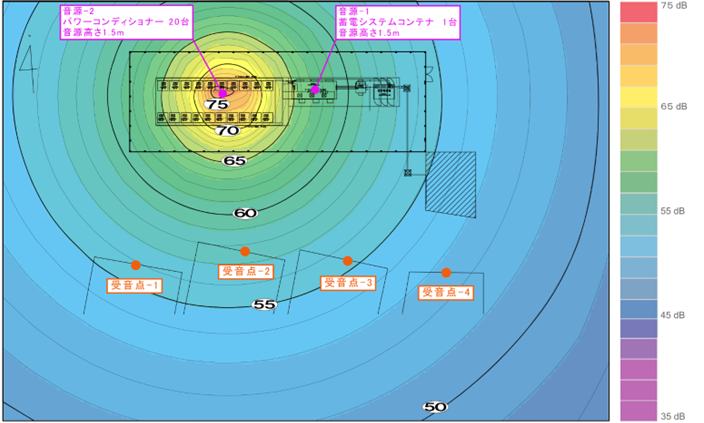
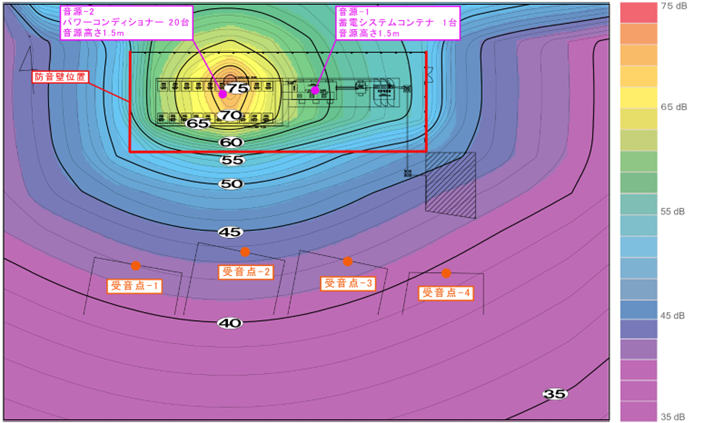
Examples of Noise Barrier Effectiveness
By installing soundproofing walls, noise can be reduced by 10dB or more.
※Effectiveness varies depending on the environment
summary
Noise control measures for battery energy storage systems are most cost-effective during the "pre-installation planning phase."
Taking countermeasures later incurs costs and risks beyond expectations, such as additional construction expenses, delays in the construction schedule, and deterioration of relations with neighbors.
If you are in this situation, please consult us immediately.
I am considering installing a battery energy storage system and am concerned about noise countermeasures.
I don't know how to comply with the Noise Regulation Act and environmental standards.
Complaints have already been received, and urgent measures are necessary.
I want to prevent noise problems after installation.
I want to know if it can be retrofitted to existing equipment.
Yakumo offers free initial consultations, on-site surveys, and noise simulations.
Whether you are a business owner or an EPC contractor, our experienced professional staff will propose the optimal solution.
─────────────────────────────────────
About Yakumo's soundproofing wall products
We offer soundproof walls specifically designed for noise control in battery storage facilities.
We will select the optimal product according to the site conditions.
🔗 Soundproofing wall product details and specifications here >

For battery storage noise countermeasures, contact Yakumo.