Are you having trouble with this?
- Noise complaints have been received from neighbors and local authorities
- Noise limits are exceeded (ISO 14000 series, compliance with noise control laws)
- We are planning to install a new machine and would like a noise prediction in advance.
- I have received guidance from the government on noise regulation, but I don't know how to proceed.
- Want to reduce the noise generated, but it is difficult to individually enclose (soundproof enclosure measures) due to space and ease of use.
To address these concerns, we propose "soundproof walls" as a solution to factory noise.
So how does a soundproof wall work?
Plant Noise Countermeasures from Three Perspectives
When sorting out noise problems, it is important to first understand where and how sound is generated and transmitted.
There are three general approaches to factory noise control
- Source measures: These are methods to make the noise source itself quieter (e.g., by improving motors and fans).
Vibration isolation measures may be effective. (SeeIndividual Noise Countermeasures) - Propagation path measure: This is a method of controlling the sound generated so that it does not spread.
Measures are taken by combining absorption (e.g., sound-absorbing materials) in the room where the sound originates + blocking the transmission of sound (e.g., soundproofing walls). - Sound-receiving point countermeasures: These are methods of protecting the sound-receiving side (e.g., sound walls, sound-insulating windows, etc.).
Soundproof walls are an effective method to control the diffusion of noise, which falls under "2.
What is a soundproof wall?
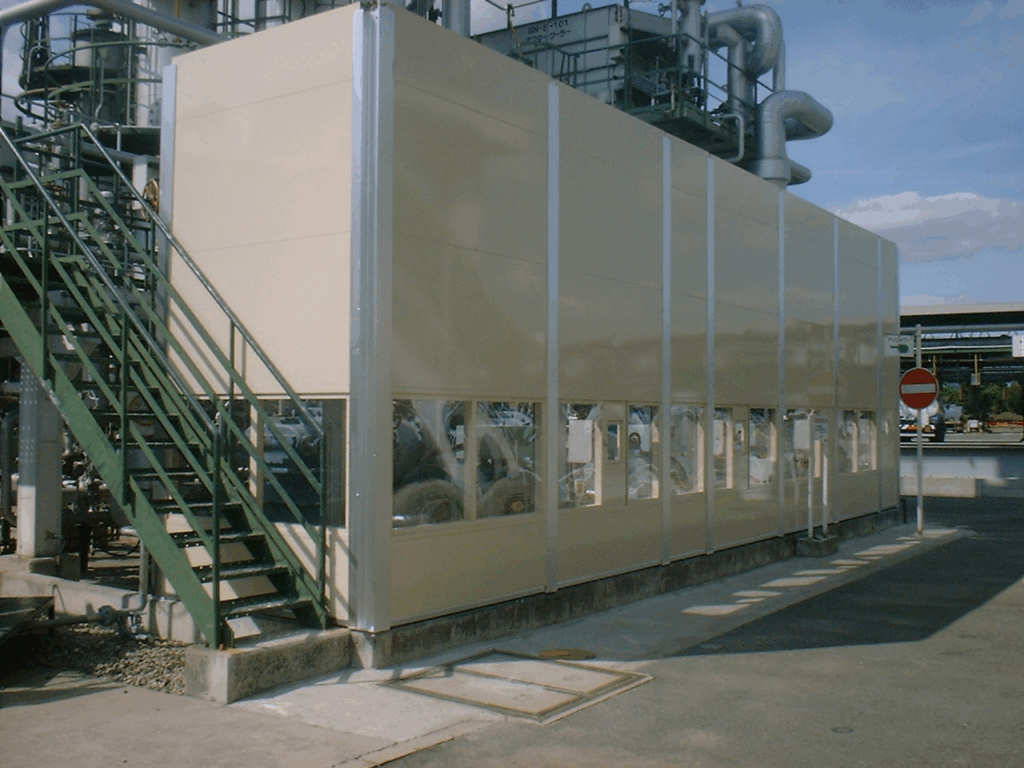
noise barrieris a structure placed between the sound source and the sound-receiving point to intercept the propagation of sound.
Sound cannot be completely blocked by an obstacle (wall), but is partially transmitted by "diffraction" that goes over the soundproofing wall and "transmission" that goes through the wall material.
The design of soundproof walls requires a detailed understanding of the sound generated and a quantitative evaluation of these sound paths to ensure the sound insulation performance required to achieve the target noise level
Calculation Method for Prevention of Noise Propagation by Soundproof Walls
Noise reduction by soundproof walls attenuates the propagation of sound using the sound diffraction phenomenon by placing a barrier between the sound source and the sound-receiving point.
Here, the sound pressure level at the receiving point is predicted comprehensively by calculating the contribution of each, taking into account the sound that goes around the top of the soundproofing wall (diffracted sound) and the sound that passes through the wall (transmitted sound).

1. calculation of diffracted sound
When a sound source directly reaching the sound-receiving point is intercepted by a soundproof wall, the sound is transmitted around the top edge of the soundproof wall. Diffracted sound (lPA1) is calculated as follows

lWASound power level of point source [dB].
ATTDiffraction attenuation of sound barrier by the Maegawa River [dB].
(From "Noise Control" Vol.15, No.4 (1991), P40, The Society of Noise Control Engineers of Japan
When installing soundproof walls
NFresnel number N = (2 × delta ) / lambda
deltaPath difference delta = (radius1 + radius2) - radius
lambdaWavelength lambda = c / f (in Japanese history) f Center frequency [Hz])
cSound propagation velocity c = 340 [m/s].
2. calculation of transmitted sound
Some sound is transmitted through the soundproof walls themselves.
Transmitted sound level (lPA2) is the wall'sTransmission Loss (TL)The following equation is obtained by considering

TLTransmission loss of soundproofing wall material [dB].
Composite noise level at the sound receiving point
At the actual sound receiving point, diffracted sound and transmitted sound exist simultaneously, so they are combined energetically to form an overall noise level (lPA(Seek).

Thus, by basing the design on quantitative predictions, it is possible to estimate the effectiveness of soundproofing from the planning stage.
To maximize the performance of soundproof walls
Installing a soundproof wall is not sufficient by itself.
Correct design and placement" will greatly affect the effectiveness of noise reduction.
In particular, there are two points that are directly related to effectiveness
- Ensure the height of the wall.
→ Reduces sound rotation (diffraction) and improves sound insulation. - Suppresses reflected sound on the sound source side
→ Use of sound-absorbing materials or sound-absorbing panels on the inside of walls can cut down on unnecessary reflected sound.
In addition, installing soundproof walls as close as possible to the sound source will increase the effectiveness of the soundproofing. In this case, it is necessary to pay attention to residual sound such as "sound coming from both ends of the soundproofing wall" and "sound passing through the wall material" and select appropriate specifications.
Soundproof walls are "one of the best solutions
The cost of major soundproofing wall construction is inevitably a concern.
It is important to consider the cost-effectiveness of the system in a step-by-step manner.
Of course, in some cases, large outdoor soundproof walls or noise reduction measures that enclose the entire factory are most effective, but this does not necessarily mean that large-scale construction is necessary from the start.
- First, low-cost measures that can be tried
Examples: Adjustment of machine operating conditions, addition of sound-absorbing materials, small-scale sound insulation measures, etc. - Additional measures to be taken if not sufficiently effective
Example: Partial enclosure, sound insulation reinforcement per surface, etc. - Final large-scale measures to be considered
Example: installation of a full-scale soundproof wall, enclosure of the entire factory
By considering this process, it will be easier to determine whether it is necessary to suddenly undertake a major construction project or whether it can be solved in other ways.
What are the first steps? What are the priorities?
If you are in doubt, the key is to organize the conditions at your site and compare the effectiveness of your measures. Please consult with us first.