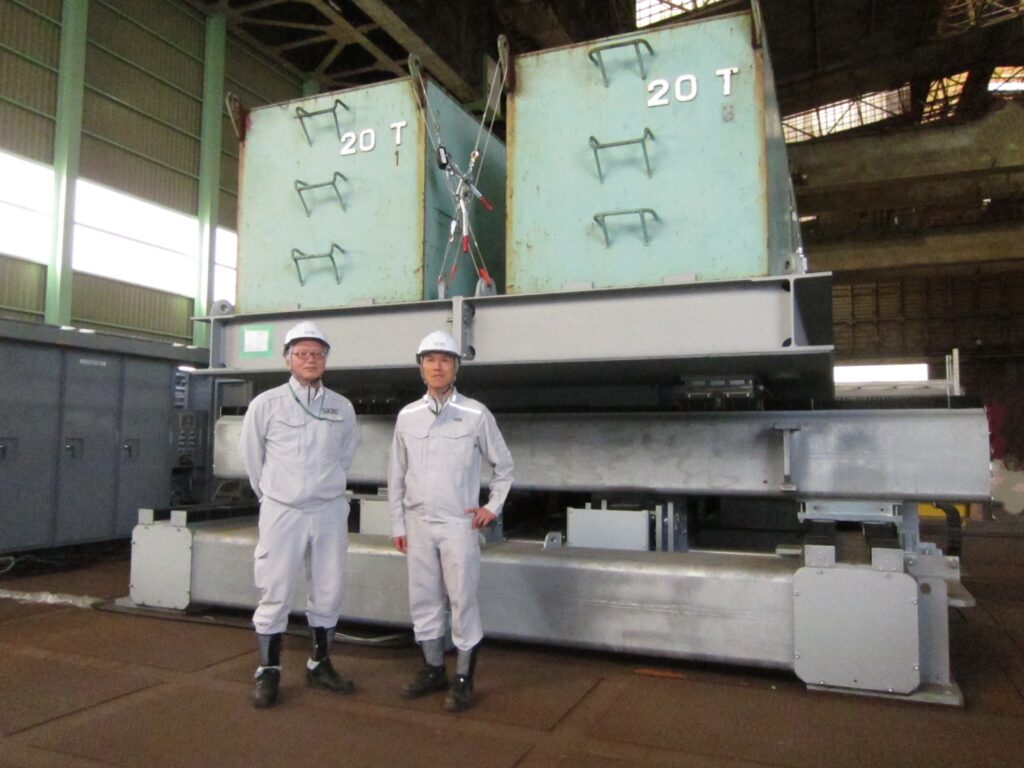
Hideyuki Funaki, President and Representative Director, Yakumo Corporation ✖ Sei Nagasaka, Deputy General Manager, Technical Group, Yakumo Corporation
Funaki:Yakumo has been designing and manufacturing TMDs (tuned mass dampers) for horizontal vibration, which are passive vibration control devices for wind sway control in high-rise buildings, and many customers have been asking us if we also offer active products.
We found that there was a market need for AMDs (active mass dampers) to reduce the swaying of high-rise buildings, thereby eliminating tenants' sense of unease and adding value to buildings. Thanks to the kindness of the owner of the building in which the AMD was installed, we are able to monitor it constantly and continue to accumulate a large amount of data, including during earthquakes. Against this backdrop, we decided that the time was ripe to enter the market for large AMDs and began development of a 100-ton AMD.
Nagasaka:We have started development of a new AMD by referring to AMDs that have been proven in the past. In a nutshell, the horizontal AMD, a device that suppresses swaying of high-rise buildings, is simply a device that moves weights horizontally. At first I thought it would not be so difficult, but when I actually tried to develop it, it was not easy because the device was large and heavy, and weather resistance, safety, and maintainability were required.
What was your development policy?
Nagasaka:As a development concept for this AMD, we aimed for performance that could meet a variety of demands. For this reason, the mass of the weight is large and the stroke is designed to be as large as possible. This is because it is relatively easy to make design changes to lower specifications if the required performance is less than this.
Also, as components, we used rather orthodox linear guides and ball screws, so-called "dead" technology. We considered using a new mechanism in a more challenging way, but we were careful not to make the development too difficult. As a result, we believe that our aim was not too bad.
The 1-ton square is now 100 tons, which makes it more difficult.What do you know?
Nagasaka:If the entire frame is large, it cannot be processed in a batch and transportation becomes inconvenient, so a segmented structure is necessary. A segmented structure makes it difficult to ensure accuracy when the frames are connected together. Also, accuracy cannot be expected due to distortion. Normally, the parallel use of linear guides and ball screws requires accuracy on the order of 100 µm, but we also struggled to create a structure that would work properly even if accuracy was not achieved.
Please let us know if there were any further difficulties.
Nagasaka:First of all, environmental resistance. AMDs for high-rise applications must withstand wind and rain because they are installed on rooftops. The cost of covering a large AMD is high if the entire unit is covered, so covers and sealing parts are added only where necessary, and anti-corrosion treatment is applied.
For example, the normal bellows for linear guides are designed for indoor dustproofing and cannot withstand direct sunlight or wind and rain, so we specially selected those that can withstand outdoor use. Individual covers and corrosion protection were one of the difficult parts.
We were also careful to ensure safety. There are three means of stopping the machine in an emergency: motor, brake, and buffer. Since the weight is extremely heavy, it was difficult to design the strength of the frame and components so that they would not break when the machine came to an abrupt stop.
The rest is the composition and arrangement of the overall equipment and frame. If the finished product has a reasonable arrangement, the viewer may not pay attention to it, saying, "Well, it usually looks like this. However, in fact, there are many things to consider in finding a good, rational arrangement, such as the operating range of the equipment, how the force is applied, and how much space is secured for assembly and maintenance work, and we had a hard time finding a good arrangement during the design process. I believe that one of the keys to a designer's skill is whether or not he or she is able to arrive at a form that "usually looks like this.
Funaki:Since we are an engineering company, we believe that we must promote our differentiated technologies, and we intend to continue to actively challenge the development of products that take advantage of Yakumo's strengths. We believe that we have gained a lot of technical knowledge through this development. Of course, we will aim for practical application of large AMDs, but we would also like to reflect the knowledge we gained this time, such as robust design methods, in other products.
Nagasaka:We would like to reflect the experience gained in this project in our future development.
For me, the greatest joy is to see what I have designed come to fruition and be useful.
I have never had the opportunity to see my designs in the public eye, but this is the first time I have designed something that is used by the general public and that people can see, so I am very happy to be involved.
We would like to continue to develop new and useful products.
~Profile~.
Sei Nagasaka, Deputy General Manager, Technical Group, Yakumo Co.
Tohoku University, Master of Engineering (Mechanical)
Specializing in mechanical design, he spent about 20 years at a research institute designing test equipment and measuring instruments for research.
After joining Yakumo, he was mainly in charge of designing vibration control equipment.