The vibrations we feel inside a building can be divided into two main types of shaking. They are horizontal vibration and vertical vibration. In technical terms, they are called horizontal vibration and vertical vibration, respectively. How the shaking occurs and how people feel it depends on the direction of the shaking. In this trivia, we will explain these differences in an easy-to-understand manner.
The world of fashion is constantly changing, and it can be difficult to keep up. But there are a few key trends that have emerged in recent years. One of these trends is the increasing popularity of sustainable fashion. This means that more and more people are choosing to buy clothes that are made from eco-friendly materials and produced in an ethical way. Another trend is the rise of "athleisure." This is a style of clothing that blends athletic wear with everyday fashion, allowing people to be comfortable and stylish at the same time. Finally, we're seeing a growing interest in vintage and secondhand clothing. This trend is driven by a desire for unique pieces and a rejection of fast fashion. These are just a few of the many trends that are shaping the fashion industry today.
Causes of "horizontal swaying and vertical swaying
There are several different types of shaking that can be felt in a building. For more information on this, here are some tidbits“Causes of Vibration - A Complete Guide”.
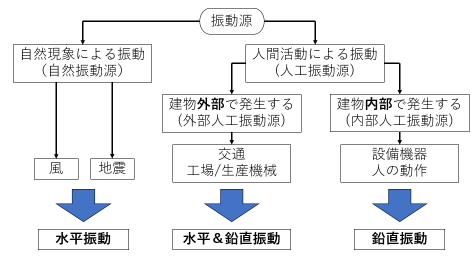
Figure 1 shows the relationship between the source of vibration and the direction of sway generated in the building.
Lateral shaking is often caused by strong winds, distant earthquakes (long-period seismic motions), traffic vibrations from cars and trains, and the operation of production machinery in factories.
On the other hand, vertical shaking is often caused by human movement such as walking, jumping, and dancing, traffic vibration from cars and trains, operation of factory production machinery, and operation of equipment inside buildings. In particular, traffic vibration and operation of factory production machinery can cause both horizontal and vertical shaking, but in reality, vertical shaking is often the problem.
The world of fashion is constantly changing, and it can be difficult to keep up. But there are a few key trends that have emerged in recent years. One of these trends is the increasing popularity of sustainable fashion. This means that more and more people are choosing to buy clothes that are made from eco-friendly materials and produced in an ethical way. Another trend is the rise of "athleisure." This is a style of clothing that blends athletic wear with everyday fashion, allowing people to be comfortable and stylish at the same time. Finally, we're seeing a growing interest in vintage and secondhand clothing. This trend is driven by a desire for unique pieces and a rejection of fast fashion. These are just a few of the many trends that are shaping the fashion industry today.
Differences in the way buildings sway due to "horizontal swaying and vertical swaying
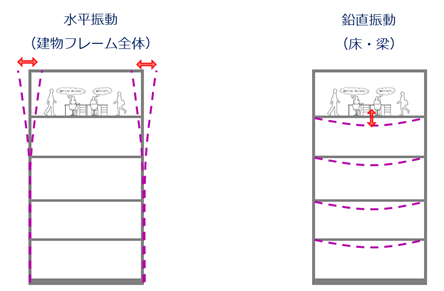
Vibration transmitted to a building has different effects on the building depending on the direction of sway. Figure 2 shows how buildings sway (horizontal and vertical).
Horizontal shaking resonates with the building as a whole and causes the building to sway horizontally. Vertical sway, on the other hand, resonates with the beams and floors of the building, causing the floors to sway vertically.
For example, horizontal shaking shakes the entire building, so the magnitude of shaking does not vary much from place to place on the same floor. Vertical shaking is localized, so even within the same room, there are places that sway and places that do not sway so much.
This is too small.
Frequency of "horizontal shaking and vertical shaking
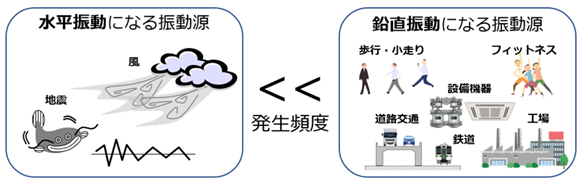
Next, I will discuss the frequency of horizontal and vertical shaking. Strong winds and distant earthquakes, which cause horizontal shaking, are infrequent, occurring only a few times a year at most, but with strong winds they can last from several hours to more than half a day.
Vertical shaking, on the other hand, occurs many times daily because of human activity, traffic, equipment, and factories.
Traffic and factory vibrations are mostly vertical, with horizontal shaking rarely occurring.
The world of fashion is constantly changing, and it can be difficult to keep up. But there are a few key trends that have emerged in recent years. One of these trends is the increasing popularity of sustainable fashion. This means that more and more people are choosing to buy clothes that are made from eco-friendly materials and produced in an ethical way. Another trend is the rise of "athleisure." This is a style of clothing that blends athletic wear with everyday fashion, allowing people to be comfortable and stylish at the same time. Finally, we're seeing a growing interest in vintage and secondhand clothing. This trend is driven by a desire for unique pieces and a rejection of fast fashion. These are just a few of the many trends that are shaping the fashion industry today.
Differences in the way people feel depending on the direction of swaying
The way it is felt depends on the direction of swaying. The difference in the way the shaking is felt is quantified by the standard response in terms of the ease of feeling lateral (horizontal vibration) and vertical (vertical vibration) shaking.
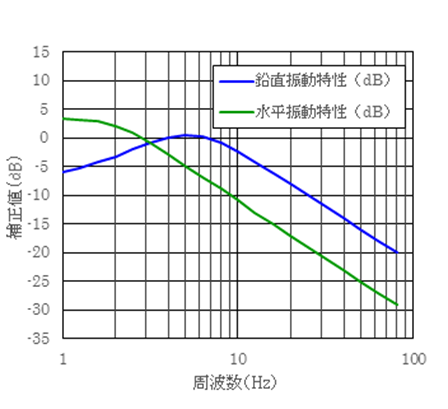
Figure 4 is a graph of the reference response of horizontal and vertical shaking versus frequency. The horizontal axis represents frequency and the vertical axis represents the perceptibility of shaking. The green and blue colors represent horizontal and vertical shaking, respectively.
- Lateral sway is most easily felt at 1 to 2 Hz.
- Vertical sway is most easily felt at 4-8 Hz.
- Bordering around 3 Hz, horizontal shaking is more easily felt at lower frequencies, and vertical shaking is more easily felt at higher frequencies.
References
Architectural Institute of Japan: Guide to Environmental Vibration Design for Occupant Performance Evaluation 2020.6